
SHOPPING BAG0 ITEMS
Your Tea Basket is Empty
Hand-harvested spring mist greens, rare Keemun blacks, and Song Ru Kiln wares await.
Explore Curated Teas →
A Ming-era saying, first told of the legendary Chai kiln and often borrowed for Ru celadon, describes the color: “Rain-washed sky blue, clouds parting after gentle rain” (雨过天青云破处,这般颜色做将来). Here is everything you need to know about this quiet Song-style celadon—the physics of ice-crack crazing, how tea liquor paints golden veins across the glaze, how to spot a well-made piece, and how to care for your cup for years.
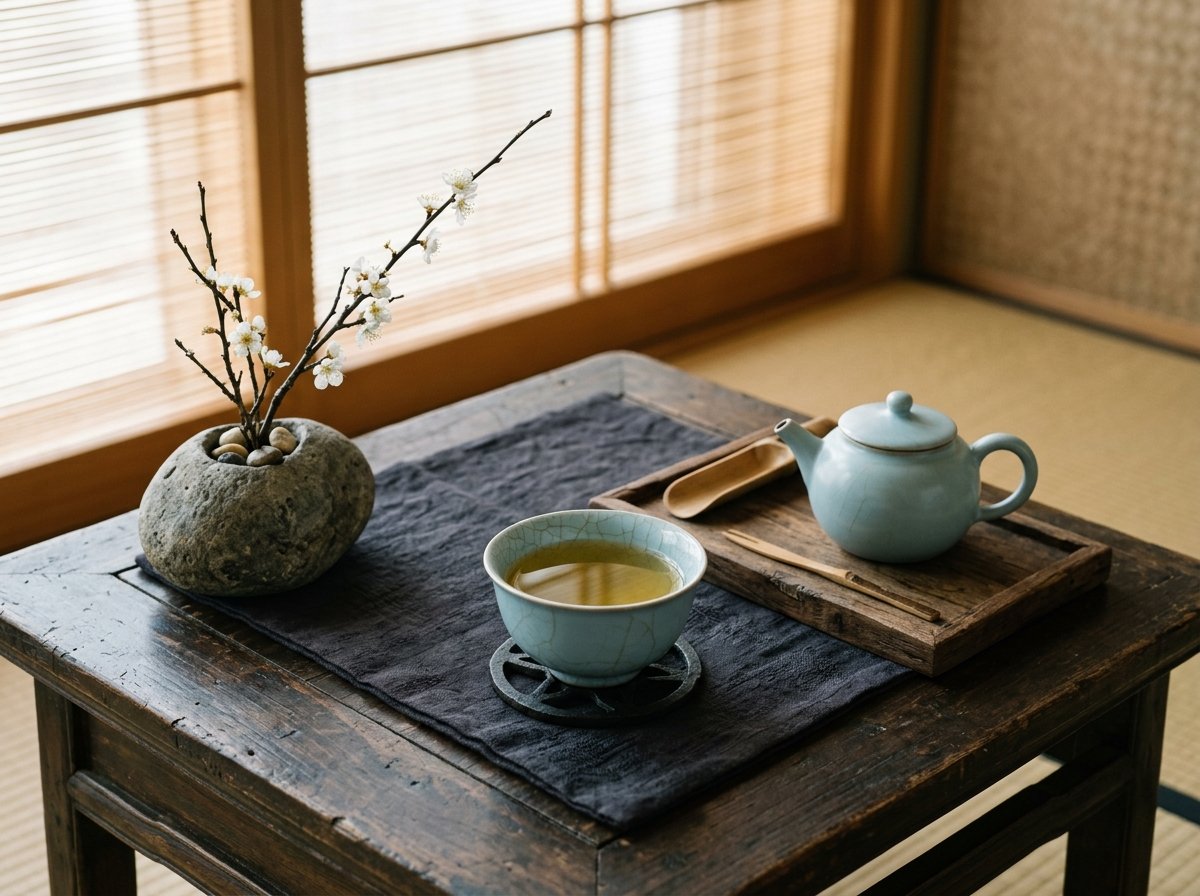
When newcomers to gongfu tea unbox their first Ru Kiln vessel, two distinct reactions usually follow. The first is reverence for the texture: held against soft daylight, well-made Ru-style celadon does not glare with mirror-bright plastic sheen. Instead, it feels cool, velvety, and deep like river jade (温润如玉). The second reaction is hesitation: “Are these tiny cracks supposed to be here? Will my cup break or leak if I pour boiling water into it?”
Understanding Ru Kiln requires stepping away from industrial notions of factory perfection. In classical Chinese ceramic philosophy, porcelain is not an inanimate piece of hardened clay. It is an evolving parchment. This comprehensive guide breaks down the history, the science of crazing, the evaluation checklist, and the daily nurturing rituals that will transform your tea sessions.
On mobile screens, swipe the table sideways to review all comparison points.
| Dimension | Well-Made Ru-Style Celadon | Cheap Imitation |
|---|---|---|
| Glaze Luster | Soft, jade-like matte glow (su you guang, 酥油光); silky and soothing to touch | Harsh, glass-like reflective glare; feels slippery and plasticky |
| Glaze Color | Natural mineral sky-blue (tianqing); shifts between duck-egg jade and soft misty gray in sunlight | Flat synthetic turquoise or electric cyan; uniform and lifeless under all lighting |
| Crazing Structure | Multi-dimensional, crystalline fissures inside the glaze; overlaps like delicate cicada wings (chan yi wen) | Surface printed or single-layer etched cracks; shallow and mechanical |
| Thermal Sound | Faint, bell-like crystalline pings (kai pian sheng) during early hot water rinses | Muffled ceramic clatter; no resonant crystalline chiming |
| Foot & Rim | Neatly finished foot; no sharp or rough edges | Rough, jagged base ring or artificially painted dark brown rim that rubs off |
| Tea Interaction | Drinks tea liquor steadily; crackle lines slowly tint amber with use | Repels liquor completely or develops murky, black mold-like blotches |
| Safety & Firing | High-temperature fired; feldspar and agate-bearing glaze over a kaolin-rich body | Low-temperature glaze of unknown composition; ask for lead/cadmium test results before drinking from it |
To understand why Ru is often ranked first among the Five Great Kilns of the Song dynasty (Ru, Guan, Ge, Ding, Jun), it helps to understand the aesthetic revolution of the Northern Song Dynasty (960–1127 CE).
Earlier Tang Dynasty pottery celebrated grandeur, rich tri-color glazes (sancai), and bold gold-rimmed silhouettes. But the Song emperors—particularly Emperor Huizong, an accomplished painter, calligrapher, and tea master—turned inward toward Taoist restraint. Huizong’s court favored a soft sky-blue glaze: neither sharp blue nor heavy green. A later Ming saying about the legendary Chai kiln, “Yu guo tian qing yun po chu” (雨过天青云破处, “the blue of the sky where the clouds break after rain”), is often borrowed to describe it.
Potters at the Ru kiln sites in Henan Province are recorded as adding agate to the glaze. Fired in a reduction atmosphere, tiny bubbles and undissolved particles in the glaze scatter light, which gives Ru ware its soft, jade-like look. When placed on your desk or dining table, it does not demand attention; it quietly calms the room.
For collectors seeking to bring this quiet elegance into daily practice, our Ru Kiln Ice Flower cup brings this look to a single ~100 ml Song-style tasting cup.
In Western industrial dinnerware, crazing is considered a manufacturing defect. In classical Chinese celadon, it is the highest form of ceramic alchemy.
The secret lies in the coefficient of thermal expansion between the ceramic body and the mineral glaze:
During the first weeks of using a fresh cup, pouring 90°C–95°C water creates gentle thermal shifts. You will hear intermittent, crystalline chimes (kai pian zhi yin, 开片之音)—a gentle, metallic ringing sound as microscopic new fissures settle into equilibrium. Some tea drinkers call this sound the “song of the kiln.”
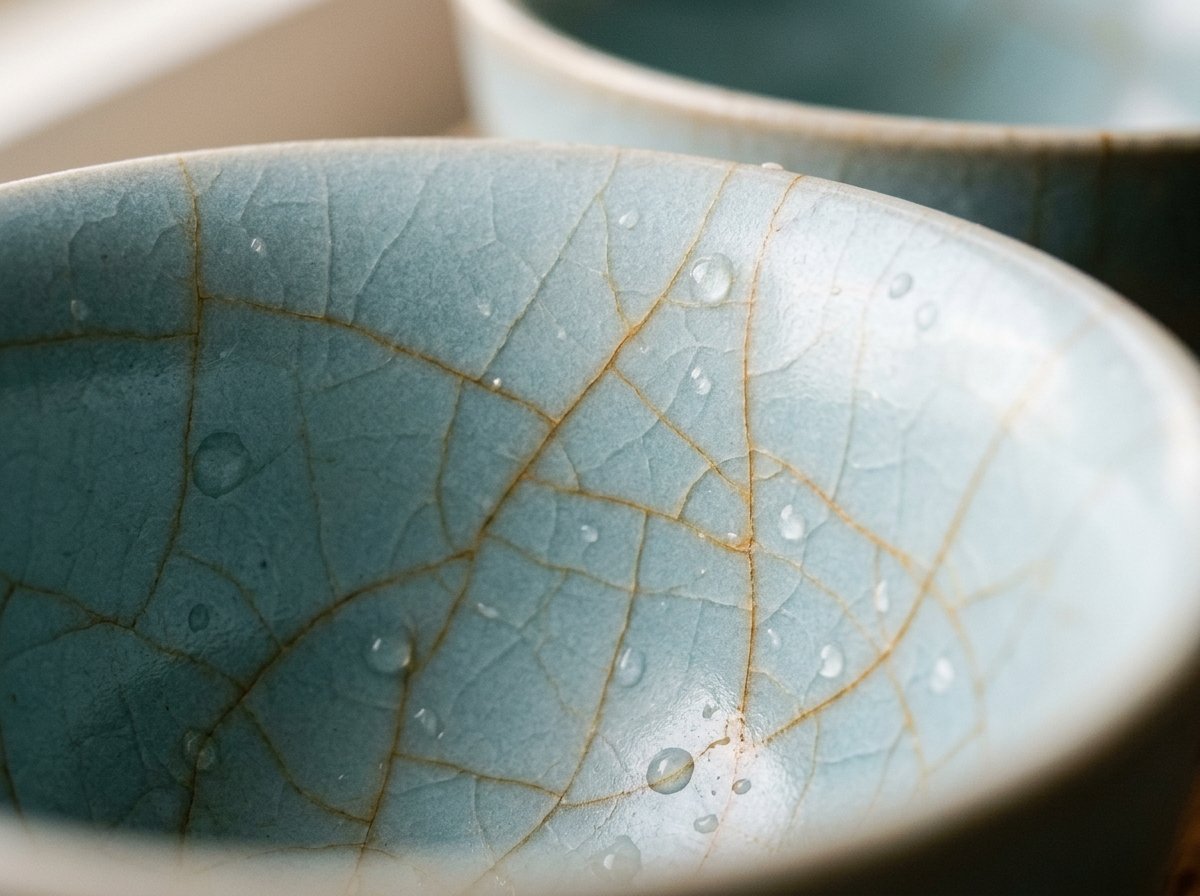
Unlike glass or stainless steel that remain sterile and indifferent over years of use, an artisanal Ru Kiln vessel forms a deep partnership with the person who brews with it. In Chinese tea culture, this journey is known as Yang Hu (养壶, raising the teapot) or Yang Bei (养杯, raising the teacup).
As hot, aromatic tea liquor washes over the vessel, natural tea tannins, theaflavins, and catechins gently settle into the microscopic fissures of the glaze. Over months of steady brewing, the transparent crack lines absorb these organic pigments, gradually tinting the crackle. (Traditionally, Ru crackle is described as “crab-claw” crazing, 蟹爪纹; “gold thread and iron wire”, 金丝铁线, is the Ge kiln signature.) The color depends on the tea:
The Collector’s Golden Rule: “One cup, one tea family.”
For the most luminous, coherent pattern, try dedicating your Ru kiln cup to one category of tea. Alternating between heavily oxidized black tea and delicate green tea in the same week can produce muddy or uneven line colors. If you love both, Keemun black tea creates the fastest and most radiant golden-amber veins.
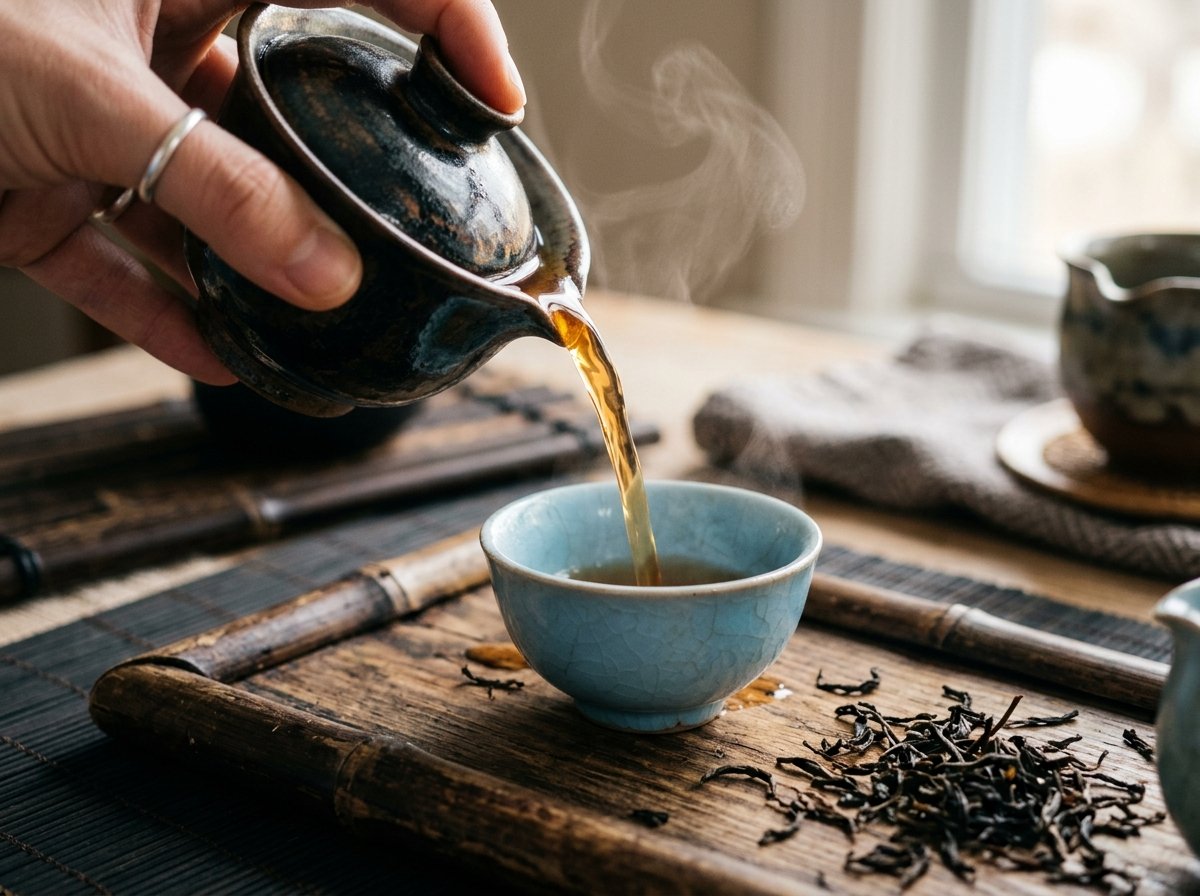
Caring for Ru Kiln is wonderfully straightforward, but requires a few intentional habits to prevent clouding the glaze luster:
Before your very first brew, place the cup in a clean basin. Rinse thoroughly with warm tap water to eliminate any kiln dust. Then, slowly pour boiling water (100°C) over the interior and exterior, letting it sit for 5 minutes. This warms the cup evenly before its first real session.
In gongfu service, warm the cup with a splash of hot water or the rinse liquor (run cha, 润茶) before each pour. A warm cup keeps the aroma lifting and the tea hotter for longer.
Start Your Own Celadon Heritage at Home
Every cup of tea leaves an indelible mark of warmth and quiet reflection. Explore our Song-style celadon, curated directly for authentic gongfu living.
Shop the Ru Kiln Ice Flower Cup Shop the Kiln-Glazed Kungfu Set
You do not need an hour of free time or a dedicated temple to experience the grounding power of Chinese tea. Try this 3-minute evening rhythm:
For more foundational steps on setting up your tea space, review our complete guide to gongfu tea ceremony for beginners.
Crackle is a glaze feature, not damage, and a well-made cup is made for everyday tea. Crackle lines do pick up tea stains and can hold residue, so rinse the cup with hot water after each session and let it dry fully.
A well-made cup should not leak: the crackle sits in the glaze layer, and the fired body underneath holds the water. Like any porcelain, it can chip or break if dropped, and sudden extreme temperature changes are best avoided.
It varies with the glaze and how often you brew. With daily black teas like Keemun or ripe Pu’er, many people notice faint tinting within a few weeks, deepening over months. Lighter green teas like Huangshan Maofeng tint much more slowly.
We don’t recommend it. Detergent and fragrance can linger in the crackle lines and taint the aroma of later brews, and dishwasher cycles risk chipping the unglazed foot rim. Rinse with hot water and dry with a clean, soft cotton tea towel.
Ordinary factory dinnerware is mass-cast from slip molds and fired in continuous tunnel kilns with uniform synthetic glazes. Ru-style celadon uses agate-bearing glazes and a careful reduction firing in which small temperature swings spoil many pieces. You are paying for that slower glazing and firing rather than mass-cast tableware.
Deepen your tea ritual with authentic terroirs, brewing insights, and artisanal teaware.
Slow cold-water extraction at 4°C preserving delicate Damascus rose aromas.
Read Guide →Understanding native Zhuyeqi terroirs, grading differences, and honeyed bouquets.
Read Guide →Pairing rich amber Keemun liquor with morning pastries and rich savory dishes.
Read Guide →Natural Agate Glaze Song Dynasty Teaset