
SHOPPING BAG0 ITEMS
Your Tea Basket is Empty
Hand-harvested spring mist greens, rare Keemun blacks, and Song Ru Kiln wares await.
Explore Curated Teas →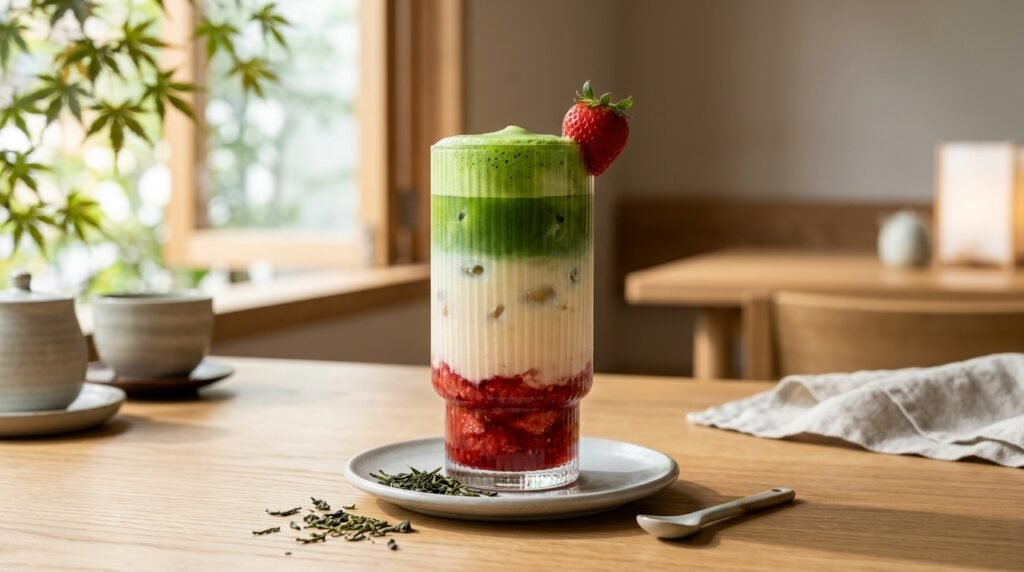
There is a moment of pure visual harmony when emerald green matcha floats serenely atop cloud-white milk, anchored by ruby-red strawberry compote. Master the physics of liquid density, the art of clump-free whisking, and the gentle inverted spoon pour to create cafe-grade tri-color layers in your own kitchen—no espresso bar equipment required.
Every failed attempt at a tri-color layered drink boils down to one fundamental principle: fluid dynamics and specific gravity. When liquids of different densities are combined without excessive kinetic force, the heavier, denser liquid will remain beneath the lighter one. However, if the densities are too similar, or if one liquid is poured with too much downward momentum, turbulence immediately forces molecular mixing, resulting in a murky olive-brown drink.
To achieve clean, Instagram-worthy separation that stays crisp while you carry your glass to the table, we balance three distinct liquid tiers:
Notice the spread: the strawberry tier is significantly heavier than milk, meaning you can pour the milk directly over the fruit puree without disturbing it, provided you introduce ice cubes first. But the difference between milk (~1.03) and water-whisked matcha (~1.00) is subtle. Use cooled matcha so it doesn’t warm and thin the milk layer. If your matcha is foamless and dense, it will plunge straight through the milk. That is why temperature control and microfoam whisking are mandatory.
The bottom layer is far more than a decorative red ribbon; it is the flavor engine that balances matcha’s vegetal astringency. Many online recipes advise simply mashing raw strawberries with a fork. While fresh, raw strawberry pulp contains high water content and jagged pulp fibers that bleed upward into milk within seconds, tinting your white tier pink before you can even take a photograph.
To build a clean, structural foundation, you have three distinct methods, each tailored to your time and pantry:
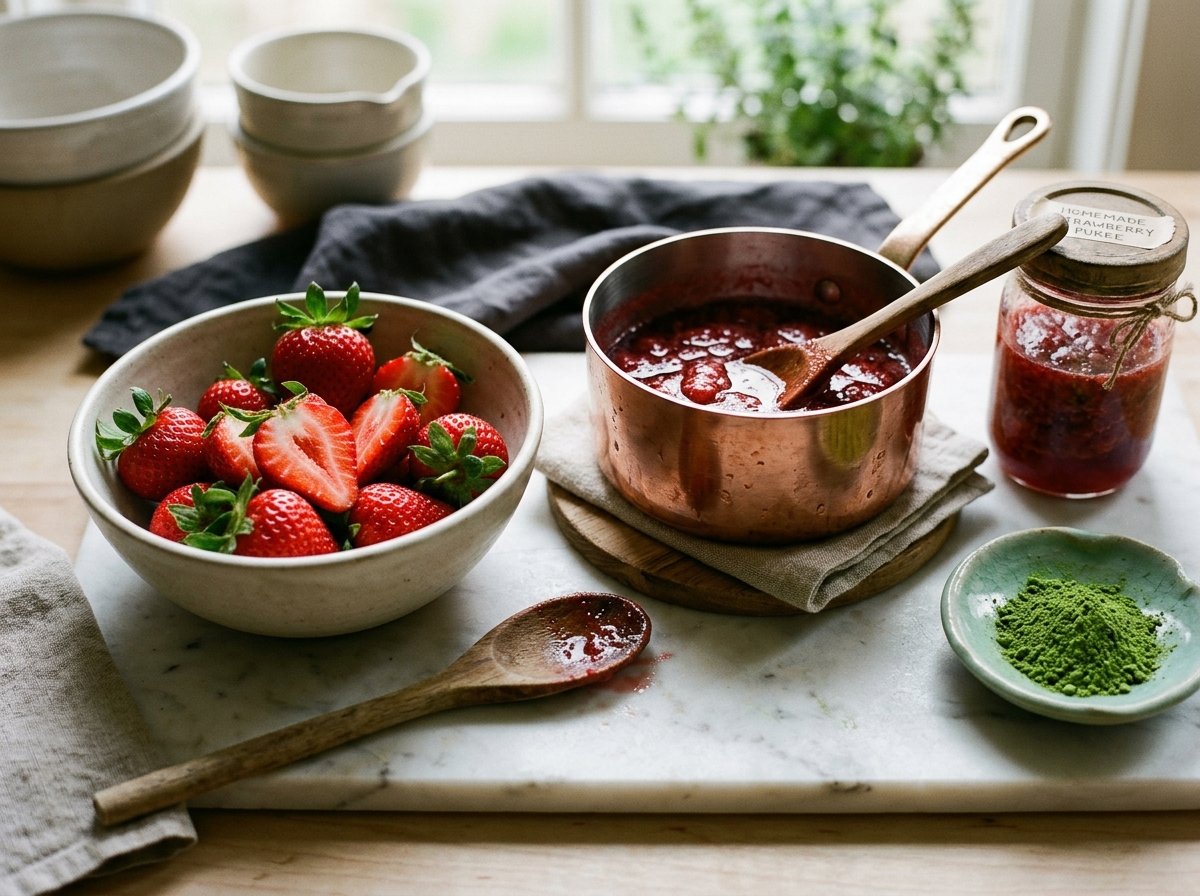
This is the definitive method used by specialty tea bars. Dice 100g of ripe strawberries and place them in a small saucepan over medium-low heat with 1 tablespoon of raw cane sugar (or maple syrup) and a squeeze of fresh lemon juice. Simmer gently for 4–5 minutes, crushing the berries with a wooden spoon until the fruit collapses into a glossy, jammy syrup. Let it cool completely in the refrigerator.
Why it works: Simmering evaporates free water and dissolves the sugar, increasing specific gravity to 1.15 g/mL. The pectin also hydrates, creating a cohesive gel that refuses to bleed into cold milk.
If you prefer an uncooked, electric berry brightness, slice fresh strawberries thinly and toss them with an equal weight of granulated sugar in a glass jar. Seal and let rest at room temperature for 4 hours, or overnight in the fridge. The sugar extracts the berry juice via osmosis, yielding a crystal-clear, intensely sweet ruby syrup packed with whole fruit gems.
For a clean keto or sugar-free lifestyle, blend ripe strawberries with a pinch of chia seeds or 1/4 teaspoon of xanthan gum. The natural gelling agents replicate the viscosity and density of traditional sugar syrup without adding refined carbohydrates, preventing the fruit from diffusing prematurely.
Matcha is shaded green tea ground into an impalpable stone-milled powder. Because powdered tea is a suspension rather than a solution, the microscopic tea leaf particles do not dissolve in water; they remain suspended through surface tension and Brownian motion.
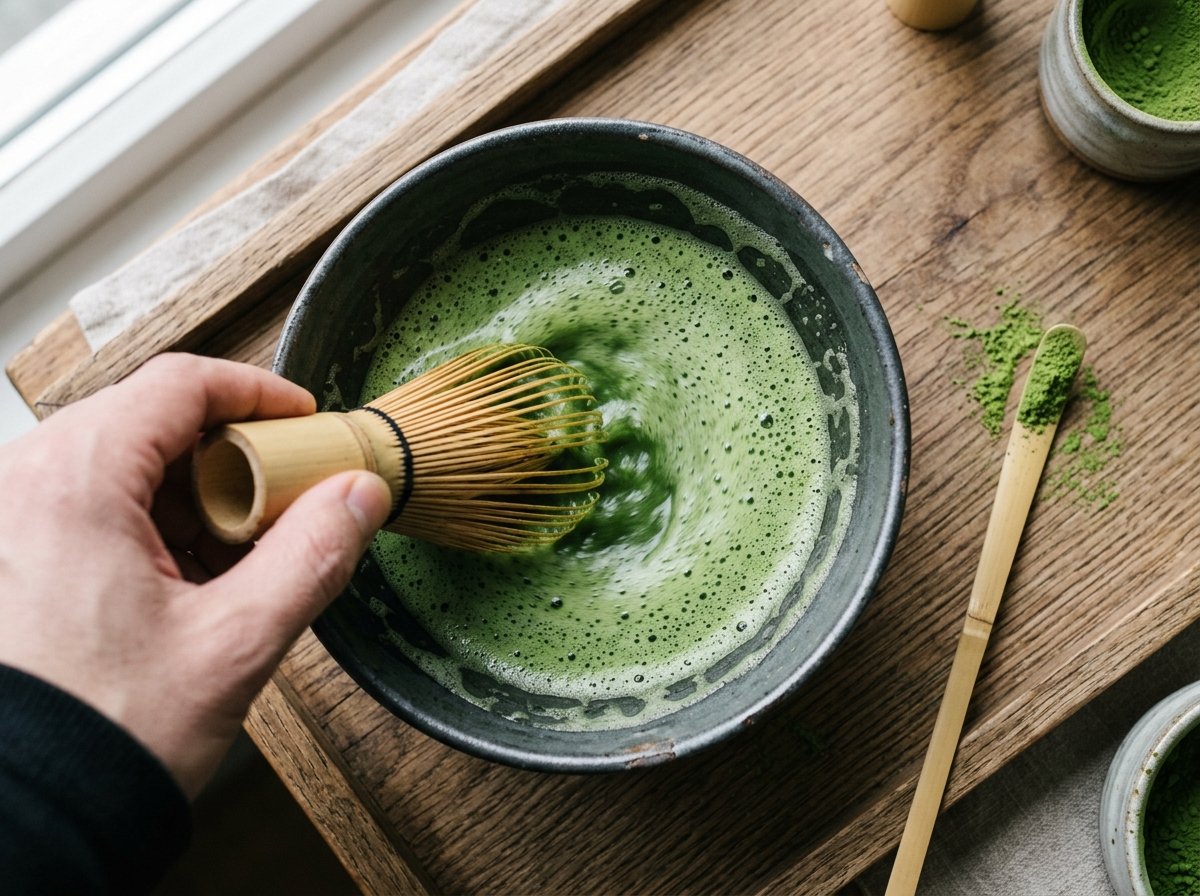
In standard baked matcha pastries or cooked sauces, culinary grade powder works because sugar and butter mask tannin astringency. However, in an iced beverage where the tea touches your palate first, use a bright, fresh, finely milled matcha such as our stone-milled matcha:
Never toss dry matcha powder into cold water. Follow this barista-proven protocol:
Your middle layer serves as the sensory bridge between bright acidic fruit and earthy vegetal tea. Selecting the right milk is not just a matter of dietary preference—it directly impacts layer longevity and flavor synergy.
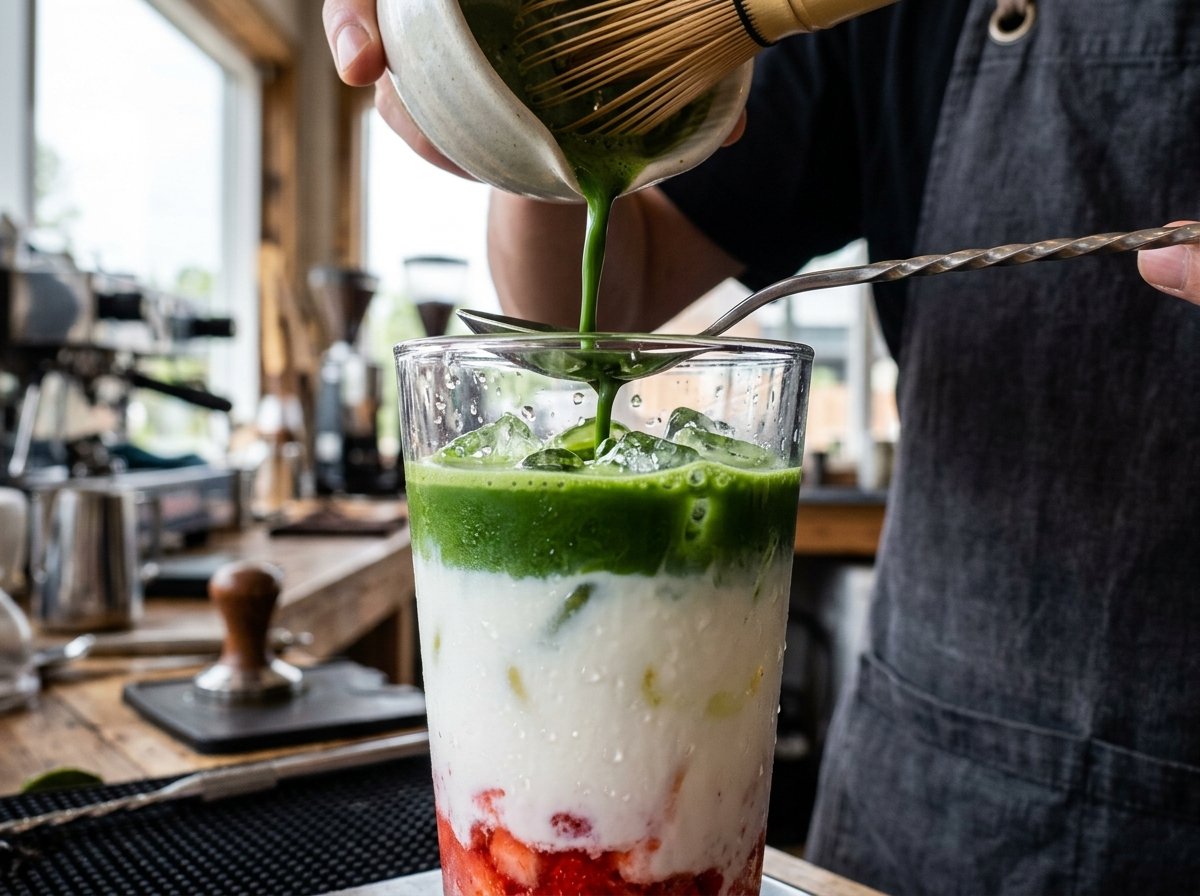
Now comes the pivotal moment of execution. You have prepared dense fruit at the bottom, silky milk in the center, and frothy matcha ready to crown the glass. How do you assemble them without ruining the visual masterpiece?
Why has the strawberry matcha latte become a worldwide cafe phenomenon? The answer lies in flavor pairing chemistry. In classical Chinese tea appreciation, green teas are treasured for their fresh, spring-harvest vegetal sweetness—a profile shared by prestigious Chinese single-origin greens such as Huangshan Maofeng and Taiping Houkui.
When you take a sip of an unmixed layered latte, your palate experiences a deliberate three-act sensory journey:
If you prefer a unified sip, swirl your straw gently. The rich grassy notes of the tea cut through the rich milk, while the strawberry’s natural acidity brightens the deep vegetal undertones into a complex, gourmet dessert.
Cause: You either poured too quickly without a spoon buffer, your matcha was hot, or you didn’t whisk in enough microfoam.
Fix: Ensure the tea is cool to the touch before pouring. Whisk vigorously for a full 20 seconds to aerate the liquid. Fill your glass with ice all the way to the rim so the matcha glides across the top ice cubes.
Cause: The strawberry mixture was too watery or lacked sufficient sugar density.
Fix: Cook the puree for an extra 2 minutes until it coats the back of a spoon. Add 1 teaspoon of honey or maple syrup to boost its specific gravity, and chill it thoroughly before pouring milk.
Cause: Water was at boiling point (100°C / 212°F) or the powder is low-grade culinary dust.
Fix: Cool your kettle water to 75°C (165°F). Use a fresher, brighter matcha — a tin that is jade green, not olive, and has been open for weeks rather than months.
Yield: 1 Serving (16 oz / 480 mL) | Prep: 8 Mins
Small fine mesh strainer, tea bowl (chawan) or small mug, bamboo whisk (chasen) or small electric frother, tall 16 oz glass, bar spoon.
You can prepare the strawberry reduction and chill it up to 5 days in advance. However, you should assemble the layers fresh right before serving. While the strawberry compote will remain separated, powdered matcha in water will gradually settle and oxidize over 45 minutes, losing its bright emerald hue and crisp boundary.
Yes, absolutely. Frozen strawberries are picked and frozen at peak ripeness, making them ideal for the stovetop reduction method. Just simmer them for an extra 2 minutes to cook off the excess condensation and water content.
“Ceremonial” is a marketing label, not a regulated grade. Bright color usually comes from young, shaded spring leaf that is freshly milled and stored well; older or later-harvest leaf, or powder that has been open too long, turns duller and more olive. Judge the tin by its color and smell, not the label.
A 2.5g to 3g serving of matcha typically provides somewhere around 50 to 130 mg of caffeine, depending on the powder — roughly one espresso shot or a little more. Matcha also contains the amino acid L-theanine, and many drinkers find it feels gentler than coffee — but it is still a caffeinated drink.
While layered drinks rely on stone-ground powdered tea for foam buoyancy, you can brew an ultra-concentrated cold infusion of spring tender green teas like Huangshan Maofeng. Froth the cold tea liquor with an electric whisk before floating it over the milk for a distinct, orchid-fragrant Chinese tea twist.
From hand-harvested high-mountain spring green teas to Song-style Ru kiln celadon teaware, explore our collection of pure terroirs and artisanal teaware crafted for mindful moments.
Deepen your tea ritual with authentic terroirs, brewing insights, and artisanal teaware.
Exploring ancestral Tang/Song roots, stone-milling physics, and culinary versatility.
Read Guide →Master tea-to-water ratios, vessel preheating, and mindfulness in daily practice.
Read Guide →Comparing the pristine whole-leaf clarity with shaded stone-milled intensity.
Read Guide →Artisanal Celadon Whisking Bowl & Stand