
SHOPPING BAG0 ITEMS
Your Tea Basket is Empty
Hand-harvested spring mist greens, rare Keemun blacks, and Song Ru Kiln wares await.
Explore Curated Teas →
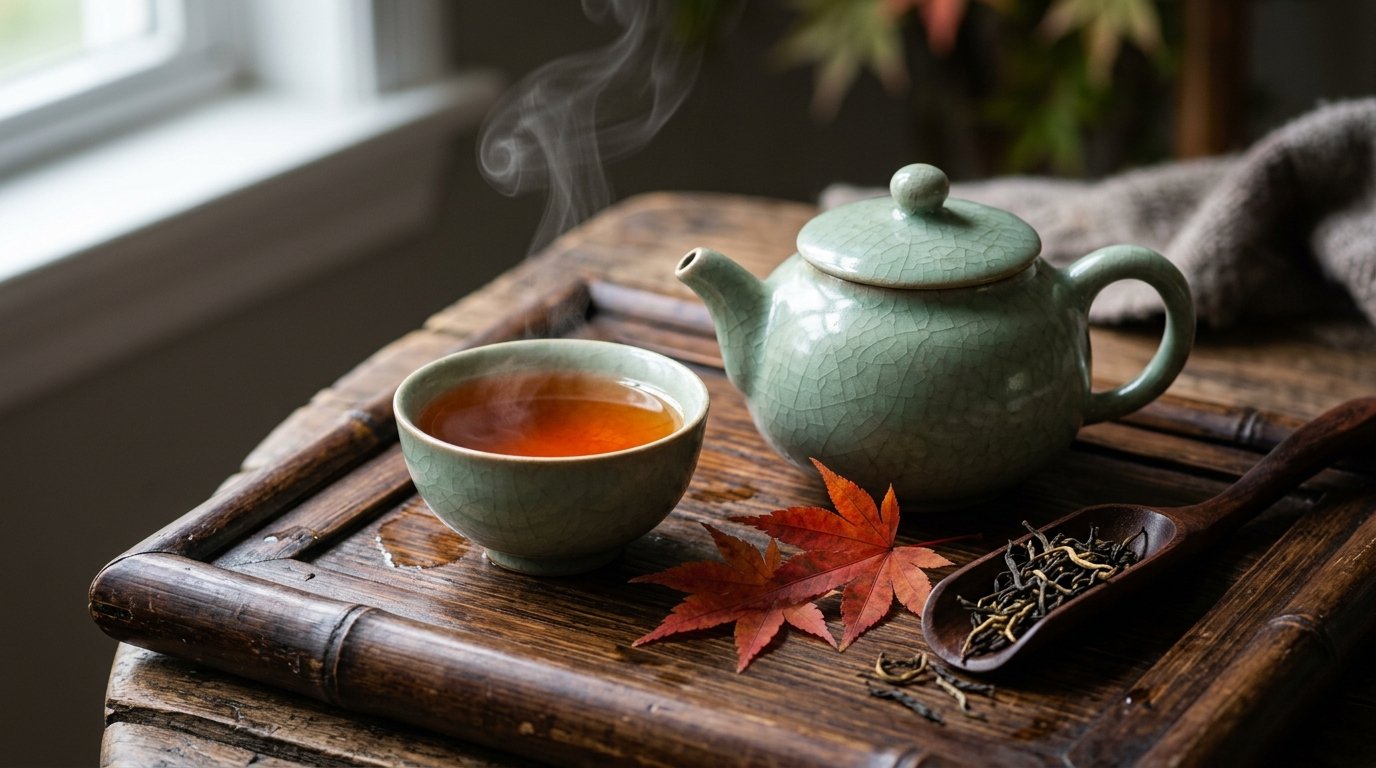
As ambient room temperatures drop below 18°C (64°F) in autumn, thin borosilicate glass and delicate porcelain suffer rapid thermal radiation losses, causing steeping water to cool by as much as 12°C within two minutes. In contrast, thick-walled Ru kiln (汝窑) celadon and high-fired stoneware possess greater specific heat capacity and microscopic insulating air pockets within their clay body. Once thoroughly preheated, these vessels create an insulated thermal cocoon that maintains steeping water in the optimal 88°C–95°C extraction zone, dissolving rich tea polysaccharides without stalling aroma volatilization.
Every tea enthusiast has experienced the autumn frustration: you boil spring water to an immaculate 96°C, pour it into your summer glass pitcher or paper-thin gaiwan, and take a sip three minutes later only to find lukewarm, flat liquor.
This happens because heat transfer scales exponentially with the temperature delta between the vessel and the ambient room air (Fourier’s Law of Thermal Conduction). In summer, when your room is 26°C, heat dissipation is modest. But on a crisp October morning when indoor temperatures dip to 15°C–18°C, uninsulated teaware bleeds thermal energy in three simultaneous vectors:
Rooted in the pinnacle of Song Dynasty ceramic craftsmanship (960–1279 AD), Ru Kiln (汝窑) Stoneware was engineered with physical properties uniquely suited for sustained heat retention.
Unlike modern industrially cast porcelain, authentic Ru kiln bodies are molded from dense, mineral-rich local clays fired at 1190°C–1220°C in a reducing atmosphere. This creates two distinct thermal advantages:
Even the finest stoneware vessel cannot retain heat if filled cold. In traditional Gongfu tea practice, the very first action is always Wen Hu Wen Bei—the intentional thermal priming of your teaware:
Crafted with natural iron-rich stoneware clay and finished in a classic Song Dynasty celadon glaze that slowly develops an intricate golden-thread crackle patina with every autumn steep. Thick walls deliver unmatched thermal stability and comforting warmth in your hands.
High-fired Ru kiln stoneware is engineered for high thermal shock resistance. However, if your teapot has been stored in an unheated room near 0°C (32°F), it is best practice to first rinse the outside with warm tap water (40°C–50°C) before pouring rolling boiling water directly into the chamber.
The micro-cracks in the glaze are intentionally formed during rapid kiln cooling. Over months of steeping amber-red teas like Keemun black tea or oolongs, natural tea polyphenols gently seep into these microscopic fissures, forming an exquisite golden network known as “Golden Thread & Iron Wire” (Jin Si Tie Xian 金丝铁线), revered as living art.
Thin porcelain gaiwans are magnificent for delicate spring green teas where rapid cooling prevents leaf scalding. However, autumn and winter teas—such as roasted Wuyi oolongs, black teas, and aged whites—require sustained 90°C+ thermal energy to extract heavy honey, dried fruit, and woody notes. Thin porcelain cools too quickly, leaving the deeper flavor layers unextracted.
Deepen your tea ritual with authentic terroirs, brewing insights, and artisanal teaware.
Comparing Anhui’s two crowning green teas in aroma, mouthfeel, and cultivar.
Read Guide →Distinguishing authentic Shi Da Cha whole leaves from machine-pressed counterfeits.
Read Guide →Learn why gentle 80°C brewing unlocks sweet L-theanine while taming tannins.
Read Guide →Handcrafted Auspicious Embossed Kungfu Set