SHOPPING BAG0 ITEMS
Your Tea Basket is Empty
Hand-harvested spring mist greens, rare Keemun blacks, and Song Ru Kiln wares await.
Explore Curated Teas →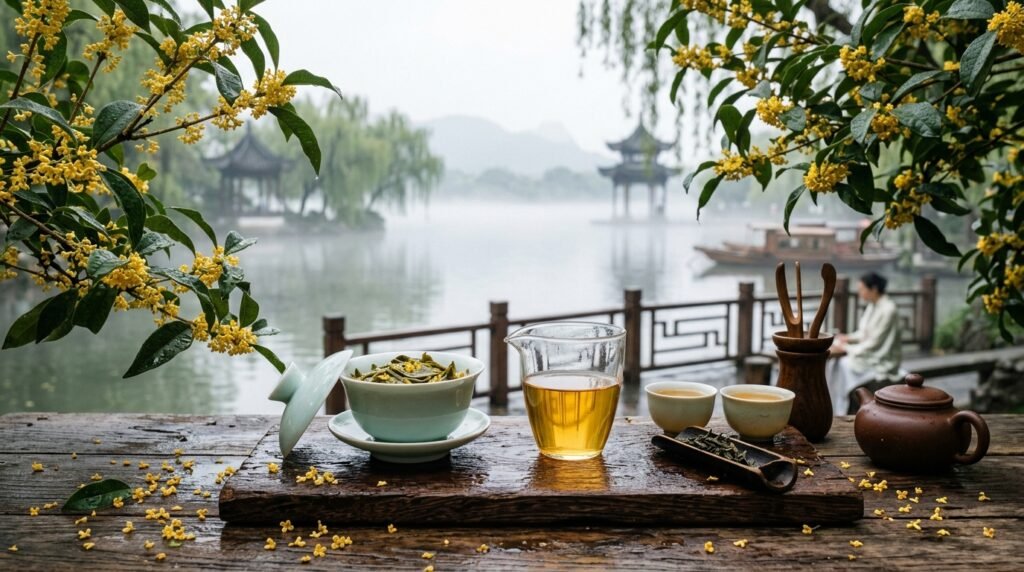
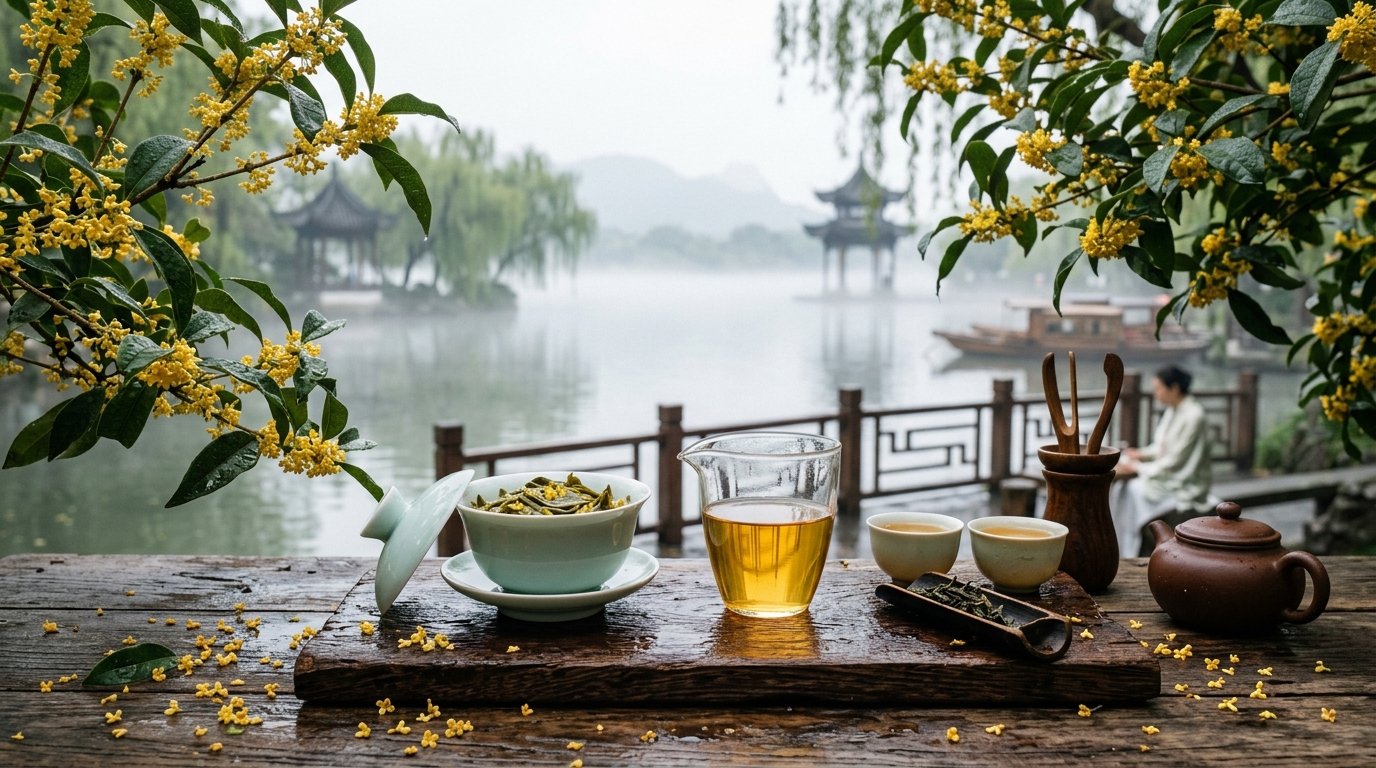
Osmanthus Tea (桂花茶 / Gui Hua Cha) pairs fresh autumnal blossoms of Osmanthus fragrans with artisan loose-leaf teas through ancient layering and absorption techniques (Xun Hua 窨花). In Hangzhou’s famed Manjuelong Valley, late autumn blossoms release ionone, linalool, and geraniol—compounds that impart apricots, ripe peaches, and honeyed floral nuances. When steeped in a neutral fresh Huangshan Maofeng green tea using soft mountain spring water, osmanthus softens the tannic bite of full-bodied black teas and highlights the natural vegetal sweetness of high-grade teas.
If spring in Hangzhou belongs to the emerald shoots of Longjing green tea, autumn belongs wholly to the golden blossoms of sweet osmanthus (Osmanthus fragrans). As late October breezes sweep across the gentle ridges flanking West Lake, millions of tiny star-shaped yellow and orange petals open simultaneously in Manjuelong Valley—a historic phenomenon celebrated for centuries as Man Long Gui Yu (“Sweet Osmanthus Rain at Manjuelong”).
The aroma is legendary: unlike the heady, heavy perfume of summer jasmine, autumn osmanthus yields a delicate, comforting fragrance evocative of wild honey, sun-ripened apricots, and sweet pear blossom. As the morning mist clings to the weeping willows and stone bridges of West Lake, tea masters and locals set bamboo tables beneath the canopy to celebrate the season’s most evocative brew.
In authentic Chinese tea culture, flavoring is never synthetic. Traditional floral teas rely on the botanical science of Xun Hua (窨花)—the art of physical aroma transmission pioneered during the Song and Ming Dynasties.
Tea leaves are naturally porous and hygroscopic; their cellular structure acts as a natural sponge for volatile essential oils. During the peak blooming window (which lasts only 4–6 days each autumn), freshly picked blossoms with pristine moisture content are carefully mixed with dry tea leaves in alternating layers:
An ancient Song Dynasty proverb proclaims: “Longjing tea paired with Tiger Spring water creates the supreme duo of Jiangnan” (西湖双绝). While this is renowned for spring green tea, few western drinkers know that the unique mineral geology of Hangzhou’s Tiger Spring (Hupao Quan 虎跑泉) is equally vital for autumn floral infusions.
Tiger Spring emerges through dense quartzite sandstones, filtering through layers of natural quartz crystal. This yields water with an exceptionally low total dissolved solids (TDS) level of around 30–50 ppm and high surface tension. When preparing delicate osmanthus teas, low-mineral water preserves the fragile aroma hydrocarbons from being bound or dampened by calcium and magnesium ions. At home, using clean, low-mineral spring water (or filtered water with TDS < 50 ppm) unlocks the exact floral brightness captured in Hangzhou’s morning pavilions.
Scented and seasonal autumn teas require inert, non-porous glazed vessels that do not trap floral oils. The silky jade glaze of our authentic Longquan celadon gaiwan provides neutral heat retention, letting the sweet apricot notes of osmanthus bloom purely without tint or residue.
Yes, but ensure the fresh flowers are clean and free of stems or roadside dust. Fresh osmanthus has high water content, so steep immediately with hot water (88°C–92°C). Do not store fresh wet petals with dry tea in a sealed tin, as the residual moisture will cause the tea leaves to mold within days.
Jasmine tea (popular in summer) is intensely crisp, white-floral, and ethereal with prominent benzyl acetate notes. Osmanthus tea (autumn) possesses a warmer, golden, nectar-like character with stone fruit (peach, apricot) undertones, creating a rounder and more grounding mouthfeel ideal for cooler weather.
A glazed porcelain or celadon gaiwan is recommended. Avoid using unglazed Yixing clay teapots for delicate floral teas, as the porous clay absorbs volatile floral esters over time and will impart residual floral aromatics to subsequent delicate green or raw puerh infusions.
Deepen your tea ritual with authentic terroirs, brewing insights, and artisanal teaware.
Comparing Anhui’s two crowning green teas in aroma, mouthfeel, and cultivar.
Read Guide →Distinguishing authentic Shi Da Cha whole leaves from machine-pressed counterfeits.
Read Guide →Learn why gentle 80°C brewing unlocks sweet L-theanine while taming tannins.
Read Guide →Handcrafted Auspicious Embossed Kungfu Set