
SHOPPING BAG0 ITEMS
Your Tea Basket is Empty
Hand-harvested spring mist greens, rare Keemun blacks, and Song Ru Kiln wares await.
Explore Curated Teas →
For over a century, Keemun black tea (祁门红茶) has enchanted tea connoisseurs across Victorian royal courts and Eastern tea pavilions alike. Yet, brewing these slender, needle-like leaves in a Western coffee mug with boiling water muffles their most sublime treasure: the elusive “Keemun Aroma” (祁门香). By introducing the traditional Gongfu Cha (工夫茶) ritual, you unlock an eight-steep symphony of dried Damascus rose, wild forest honey, and ancient Chinese cedarwood.
In This Masterclass:
When most Western tea drinkers prepare black tea, they drop a single teaspoon of leaves into 350 mL of rolling boiling water (100°C / 212°F) and steep for three to five minutes. While this works adequately for industrial CTC (Crush, Tear, Curl) breakfast teas designed to carry milk and sugar, applying this method to authentic artisanal Keemun Black Tea results in tragedy.
Handcrafted orthodox Keemun is harvested from the native Zhuyeqi (槠叶齐) cultivar in Anhui’s misty Huangshan mountain range. Its tender spring leaves contain an astonishing concentration of delicate volatile aromatic alcohols—principally geraniol and linalool. When subjected to prolonged, stagnant immersion in boiling water, these delicate aromatic esters boil off within seconds, leaving behind harsh, concentrated polyphenols and tannins.
Gongfu brewing reverses this dynamic entirely: by employing a high leaf-to-water ratio (5 grams per 110 mL) paired with lightning-fast steeps (10 to 20 seconds), you selectively tease out the exquisite floral top notes and natural fruit sweetness while preventing bitter astringency from overwhelming the cup.
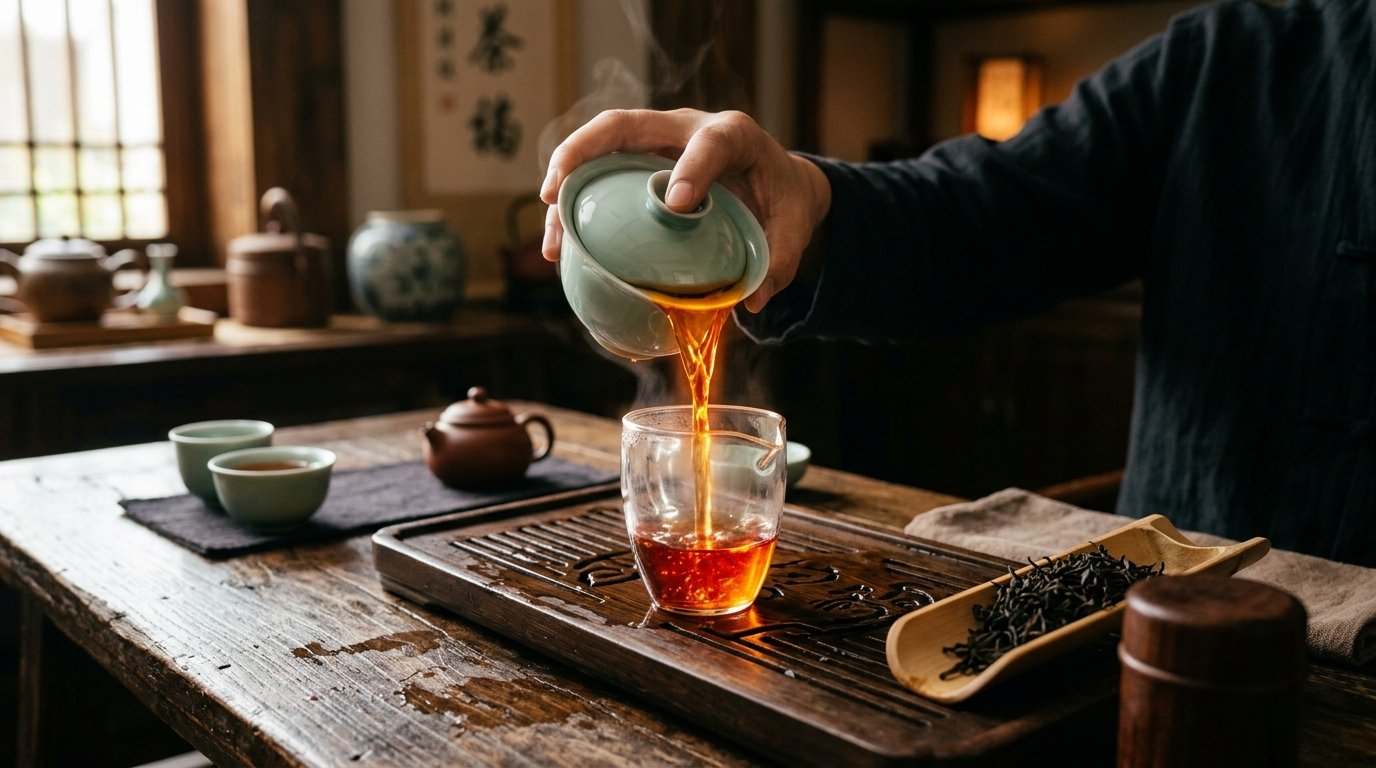
Selecting the right brewing vessel is paramount when evaluating Keemun’s layered personality. Here is how the three canonical Chinese vessels interact with Keemun:
In the words of Ming Dynasty tea sage Lu Yu, “Water is the mother of tea.” You cannot coax world-class aroma from exceptional leaves using municipal tap water burdened with chlorine and high limestone minerals.
Set aside 20 minutes for quiet mindfulness. Prepare your gaiwan, fairness pitcher (cha hai), and two small tasting cups.
One of the supreme joys of Gongfu brewing is watching high-mountain Keemun evolve across repeated infusions. Here is what an authentic spring harvest reveals:
| Infusion | Steep Time | Liquor Character | Sensory Tasting Notes |
|---|---|---|---|
| Steep 1 | 12 seconds | Luminous bright amber | Immediate rush of fresh Damascus rose, sweet malt, silky viscosity. |
| Steep 2 & 3 (Peak) | 15 – 20 seconds | Deep glowing ruby-red | Signature “Keemun Aroma” at its zenith: wild wildflower honey, baked apple, subtle Chinese cedar, prominent golden rim. |
| Steep 4 & 5 | 25 – 35 seconds | Rich warm amber | Floral notes gently subside; warm dried apricot, dark cacao nibs, and lingering throat sweetness (Hui Gan). |
| Steep 6 to 8 | 45 – 70 seconds | Clear golden honey | Clean woody sweetness, sweet sugarcane liquor, soothing and completely free of bitterness. |
While industrial CTC English breakfast tea requires milk to temper heavy bitterness, artisanal whole-leaf Keemun brewed Gongfu style is naturally sweet, aromatic, and low in astringency. Adding milk masks the nuanced rose-and-honey esters. We strongly recommend savoring it pure.
In Chinese tea evaluation, this is revered as the “Golden Ring” (金圈, Jin Quan). It forms when high concentrations of beneficial theaflavins (golden pigments produced during precise enzymatic oxidation) rise to the perimeter of the cup, serving as a reliable benchmark of authentic orthodox craftsmanship.
Always keep loose leaves sealed inside multi-layer oxygen-barrier aluminum pouches or tin caddies with airtight double lids. Store at room temperature (20°C / 68°F) in a dark, dry pantry away from spices, coffee, or kitchen aromas. Unlike green tea, Keemun does not require refrigeration.
Deepen your tea ritual with authentic terroirs, brewing insights, and artisanal teaware.
Why Song Dynasty natural agate glazes develop auspicious golden tea veins.
Read Guide →Slow cold-water extraction at 4°C preserving delicate Damascus rose aromas.
Read Guide →Understanding native Zhuyeqi terroirs, grading differences, and honeyed bouquets.
Read Guide →Natural Agate Glaze Song Dynasty Teaset