
SHOPPING BAG0 ITEMS
Your Tea Basket is Empty
Hand-harvested spring mist greens, rare Keemun blacks, and Song Ru Kiln wares await.
Explore Curated Teas →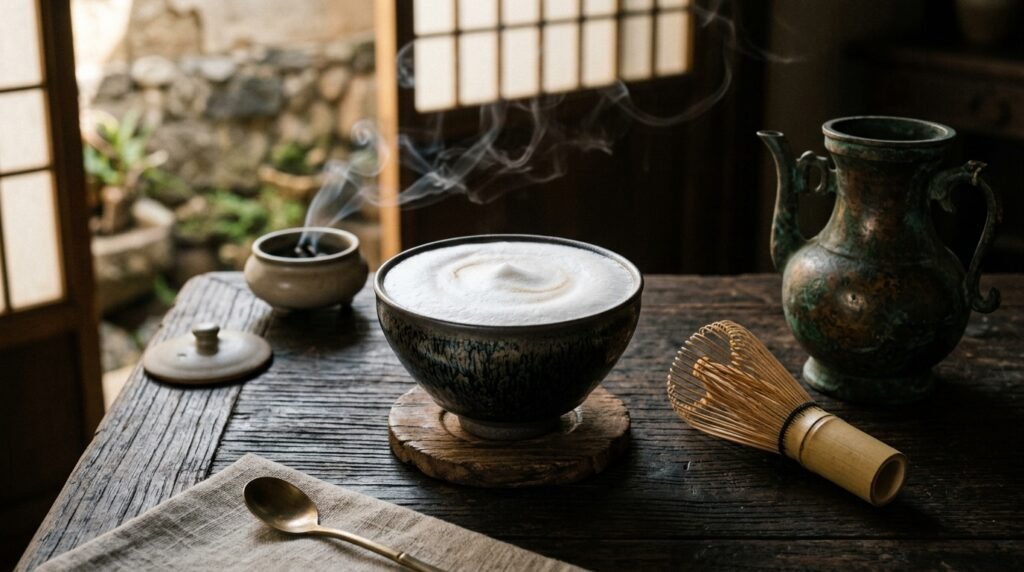
Long before the modern world discovered matcha lattes, the scholar-aesthetes of China’s Song Dynasty (960–1279 CE) perfected the world’s most sophisticated whipped tea ceremony: Dian Cha (点茶). In an era when poetry, calligraphy, and tea were revered as pathways to enlightenment, Emperor Huizong personally penned the definitive treatise on creating snowy white tea foam that could “bite the bowl” for hours.
In This Masterclass:
While Western history remembers the Song Dynasty for its porcelain and landscape painting, its cultural elite reserved their deepest passion for tea battles (Dou Cha, 斗茶). Courtiers, poets like Su Shi, and Zen Buddhist monks gathered in serene pavilions to whip powdered tea into exquisite foam.
In his landmark 1107 CE text, Treatise on Tea (大观茶论), Emperor Huizong laid down the ultimate benchmark: the ideal whipped tea should possess a color as pure as pristine snow (Bai Ru Chun Xue) and an emulsion so tight that the foam clings tenaciously to the ceramic rim of the bowl without receding—a phenomenon called Yao Zhan (咬盏, “biting the bowl”).
Few Western tea drinkers realize that modern Japanese matcha is the direct descendant of Song Dynasty Dian Cha. During the 12th century, the Japanese Zen master Eisai studied Buddhism in the misty Tianmu Mountain temples of Zhejiang, China. When he returned to Japan, he carried with him tea seeds, bamboo whisks (chasen), and the precise Dian Cha rituals of Song Zen monasteries.
While the Ming Dynasty in 1391 decreed a transition to loose-leaf steeping (giving birth to modern whole-leaf Gongfu tea), the whipped powdered tea tradition remained preserved across the sea. At Xiangcha, our aesthetic honors both traditions: the pristine whole-leaf clarity of Huangshan Maofeng and the ancient meditative discipline of whipped tea.
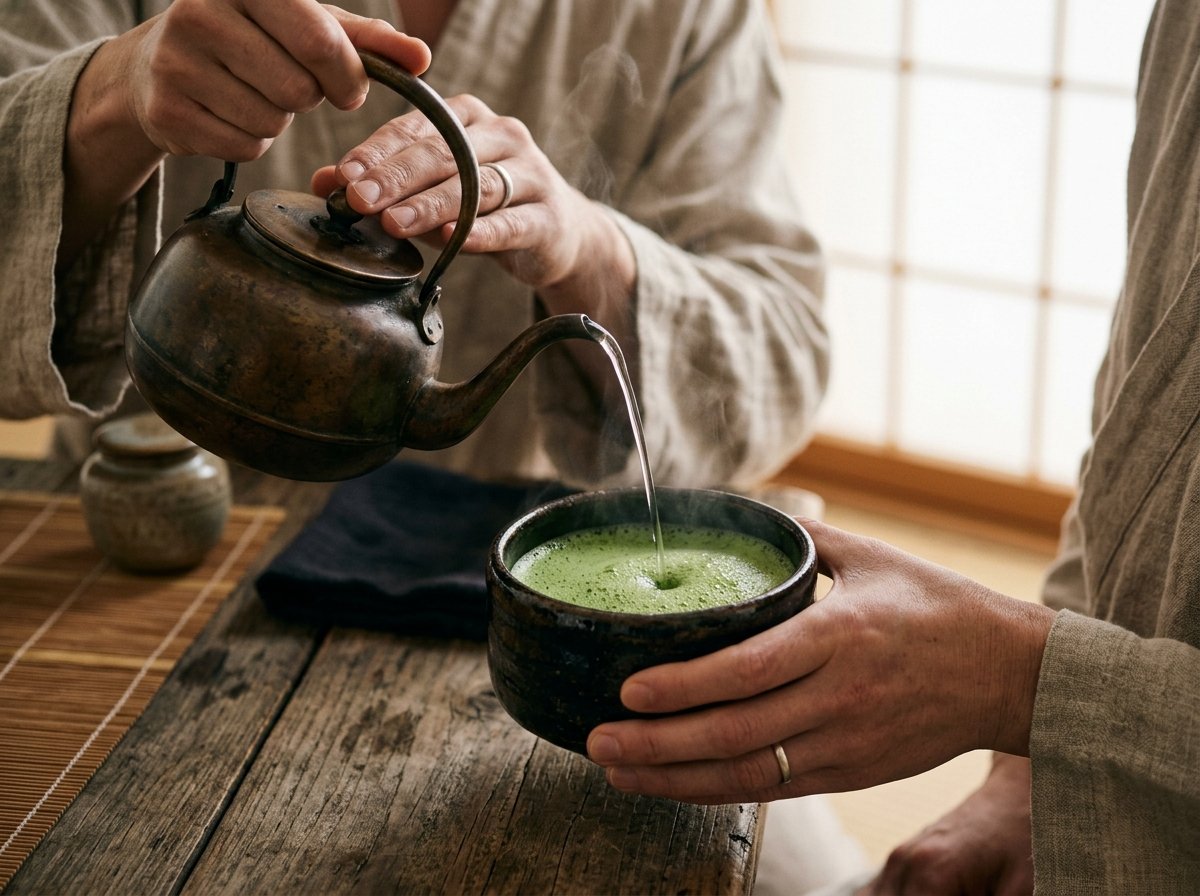
Unlike modern matcha preparation which adds water all at once, Emperor Huizong mastered the Seven Pours (Qi Tang Fa, 七汤法). Adding water in measured stages progressively hydrates and stabilizes tea saponins without drowning the emulsion:
Why did Song Dynasty tea connoisseurs insist on using deep black or dark brown ceramic bowls from Jianyang, Fujian (known as Jianzhan, 建盏) rather than light celadon?
The answer is contrast aesthetic (Qi Se, 契色). In tea battles, judges evaluated the whiteness of the foam. In a white porcelain cup, pale foam vanishes visually. In a dark Jianzhan bowl featuring iron-rich “Hare’s Fur” (兔毫) or “Oil Spot” (油滴) crystalline glazes, the radiant white foam glows like the full moon rising against an ink-black midnight sky.
Furthermore, Jianzhan bowls have thick, heavy stoneware walls that hold intense heat, keeping the whipped tea warm during contemplative philosophical discussions.
Once a pristine, mirror-like foam was created, ancient tea artists practiced Cha Bai Xi (茶百戏, The Hundred Games of Tea). Using only clear water dipped onto the tip of a fine bamboo spoon or brush, the master would delicately touch the surface tension of the dense foam.
The clear water displaced the microscopic tea bubbles, creating ethereal, temporary ink-and-wash brush strokes resembling mountain landscapes, wild geese in flight, or classical poetic couplets. It was the world’s very first “latte art”—celebrated not as commercial decoration, but as a fleeting meditation on the impermanence of beauty.
You do not need an ancient palace to experience the grounding peace of Dian Cha. Integrate this 10-minute mindful ritual into your morning routine:
Style: Traditional Whipped Tea Ritual
Song Dynasty imperial tea cakes were crafted from early spring tea bud hearts that were stripped of their outer leaves, steamed, and repeatedly pressed to remove chlorophyll and bitterness. Combined with the refraction of light through millions of microscopic bubbles, the resulting whipped foam appeared as white as snow.
Yes, absolutely! Modern ceremonial grade matcha is stone-ground under identical principles. It will produce a luminous jade-colored foam with exquisite sweetness and umami that beautifully revives the Song ritual.
“Yao Zhan” refers to tea foam whose microbubbles have such high surface tension that the foam clings firmly to the ceramic wall of the bowl without separating or leaving a watery waterline (Shui Hen, 水痕). The longer the foam clings, the higher the practitioner’s skill.
A heavy splash of water creates turbulent downward momentum that shatters existing foam. An arc pour from a gooseneck or long-spout kettle allows water to slide smoothly down the side of the bowl, preserving bubble stability.
Dian Cha (Song Dynasty) is a powdered, whipped tea ritual where the tea powder is ingested in suspension with water. Gongfu Cha (Ming and Qing Dynasties to modern day) is a whole-leaf steeping ceremony where water extracts soluble compounds from leaves before being strained and discarded.
Step away from the fast-paced modern world and experience the timeless mindfulness of ancient Chinese tea rituals with handcrafted teaware from Xiangcha.
Deepen your tea ritual with authentic terroirs, brewing insights, and artisanal teaware.
Comparing Anhui’s two crowning green teas in aroma, mouthfeel, and cultivar.
Read Guide →Distinguishing authentic Shi Da Cha whole leaves from machine-pressed counterfeits.
Read Guide →Learn why gentle 80°C brewing unlocks sweet L-theanine while taming tannins.
Read Guide →Handcrafted Auspicious Embossed Kungfu Set