
SHOPPING BAG0 ITEMS
Your Tea Basket is Empty
Hand-harvested spring mist greens, rare Keemun blacks, and Song Ru Kiln wares await.
Explore Curated Teas →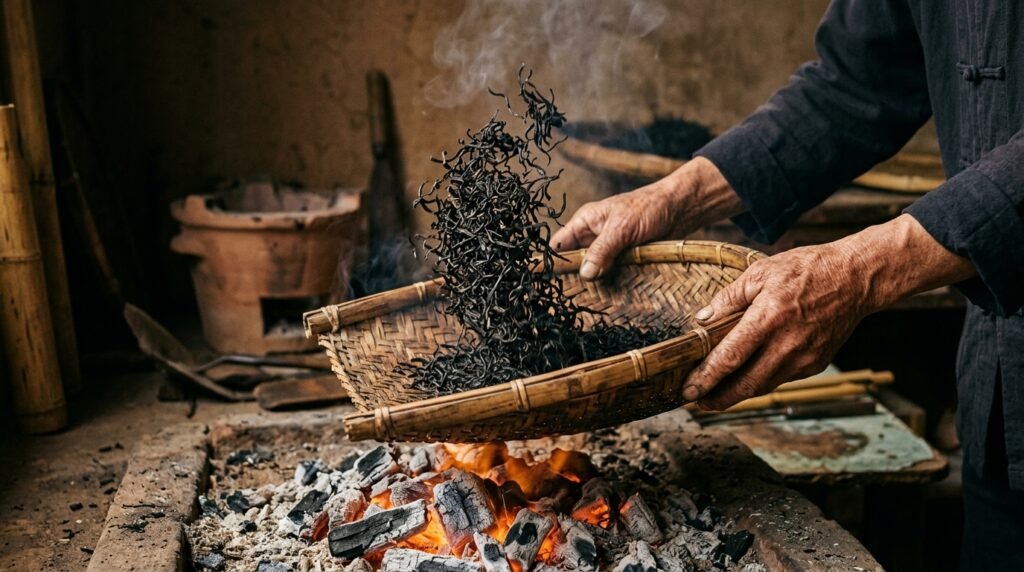
In international sensory lexicons, the fragrance of single-origin Keemun black tea (祁门红茶) is so singular and unmistakable that flavor chemists and world tea sommeliers do not compare it to other teas. Instead, they simply call it the “Keemun Aroma” (祁门香, Qimen Xiang). But what exact biochemical compounds create this enchanting perfume of dried Damascus rose, wild honey, and Chinese cedarwood—and how does a grueling 17-step orthodox heritage craft summon it into being?
In This Technical Deep Dive:
Modern gas chromatography-mass spectrometry (GC-MS) has solved the century-old mystery that bewitched nineteenth-century European tasters. When you inhale the steam rising from an authentic cup of Keemun Black Tea, your olfactory bulb is registering a rare convergence of volatile monoterpenoids and aromatic alcohols:
You cannot produce Keemun Aroma from just any tea plant. The chemical precursor molecules reside inside the native Zhuyeqi (槠叶齐) cultivar, an indigenous medium-leaf variety that evolved over millennia in the isolated ravines of Qimen and Huangshan.
Zhuyeqi leaves have exceptionally dense spongy mesophyll tissue with double the concentration of glandular hairs and bound glycosides compared to ordinary tea bushes. In the fresh leaf, these aromatic compounds are “locked” inside non-volatile glycoside bonds. Only through specialized orthodox fermentation and careful dehydration are these bonds cleaved, releasing the free, fragrant volatile alcohols into the air.
Authentic Gongfu Keemun is famously celebrated as the most labor-intensive black tea on earth. Its fabrication is divided into two distinct grand phases: Primary Processing (Chu Zhi, 初制) and Refined Processing (Jing Zhi, 精制), spanning seventeen sequential procedures:
During the spring harvest, freshly plucked one-bud-and-two-leaf sprigs are spread across bamboo racks to wither until the moisture drops from 75% down to 60%. The leaves turn supple and pliable.
In the rolling room, mechanical and hand rollers rupture the plant cell walls (reaching an optimal 80% to 85% cell disruption rate). Polyphenol oxidase (PPO) and peroxidase enzymes encounter catechins in the presence of oxygen. During the subsequent 4-to-6 hour fermentation in temperature-controlled rooms (22°C to 24°C, 90% humidity), astringent catechins undergo enzymatic oxidative condensation, generating:
While primary processing transforms green leaf into crude black tea (Mao Cha), it is the subsequent Jing Zhi (精制) phase that earns Keemun its global royal stature. Using seven graduated bamboo sieves (ranging from coarse mesh to microscopic silk), craftsmen sort the tea by leaf length, thickness, and density.
Wind winnowers separate heavy tender heartwood leaves from lighter fibrous leaf flakes. Veteran artisans then spend days hand-plucking every stray tea stem and yellow leaf flaw. This unyielding standard ensures that every gram of the finished lot is uniform in size, tight as a sewing needle, and glossy jet-black with golden tips.
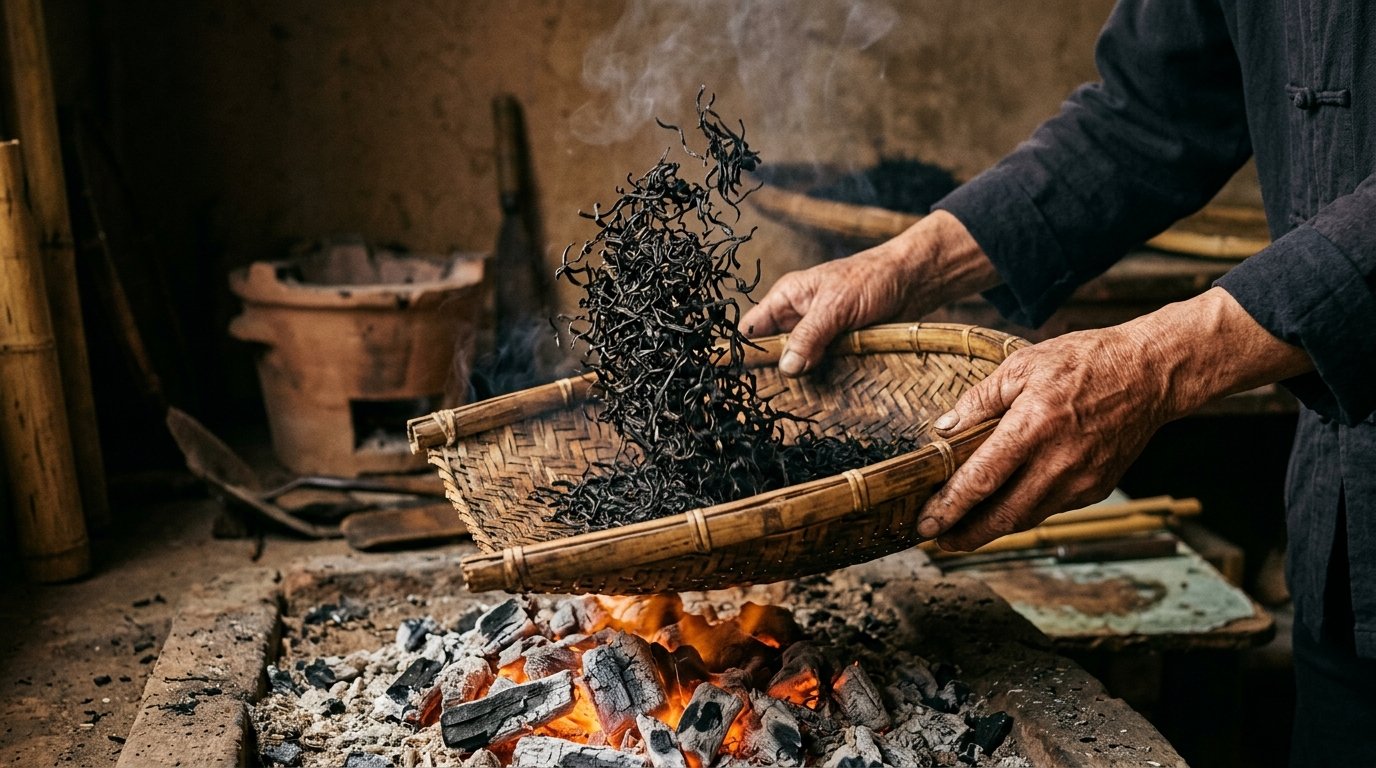
The crowning glory of Keemun orthodox craft is the final firing (Hong Bei). The sifted tea is packed into linen bags and placed on hour-glass bamboo baskets (Hong Long) suspended over pits of natural fruitwood charcoal covered in a fine insulating layer of white ash.
At a gentle, steady heat of 75°C to 85°C (167°F to 185°F), the remaining residual moisture drops below 6.5%. More importantly, the gentle thermal radiation triggers non-enzymatic Maillard caramelization: sugars and amino acids merge, locking in the geraniol and volatilizing any raw vegetative notes. When brewed in a warm Ru Kiln celadon cup, this caramel-roasted barrier dissolves instantly, sending waves of rose perfume into the room.
| Chemical Parameter | Artisanal Orthodox Keemun | Industrial CTC Tea Bag |
|---|---|---|
| Geraniol Proportion (Floral Rose) | 50% to 65% of total essential oils | Less than 5% (destroyed by high heat) |
| Whole Leaf Integrity | Intact wiry needle tips; cell walls uncrushed | Macerated dust & fannings; cells destroyed |
| Tannic Astringency Index | Very Low; high theaflavins & amino acids | High; instant harsh catechin release |
| Steeping Longevity | 8 to 10 rewarding Gongfu infusions | 1 single rapid steep; spent immediately |
100% natural. Authentic Keemun black tea is never flavored with oils, artificial perfumes, or rose petals. Every molecule of rose, wild honey, and cedar fragrance is synthesized naturally by the living Zhuyeqi tea bush and liberated through traditional orthodox oxidation.
Historically, some commercial grades were dried with open wood fires, imparting an accidental smoky flavor (similar to Lapsang Souchong). True top-tier orthodox Keemun uses ash-covered charcoal baskets with zero open flame, producing a sweet, floral, and woody profile with no acrid smoke.
Geraniol boils and evaporates rapidly above 95°C. By brewing at 90°C to 92°C (194°F) in a porcelain or celadon gaiwan, you maintain the optimal temperature that extracts sweet amino acids and allows fragrant geraniol vapors to rise gently without scorching.
Deepen your tea ritual with authentic terroirs, brewing insights, and artisanal teaware.
Why Song Dynasty natural agate glazes develop auspicious golden tea veins.
Read Guide →Slow cold-water extraction at 4°C preserving delicate Damascus rose aromas.
Read Guide →Understanding native Zhuyeqi terroirs, grading differences, and honeyed bouquets.
Read Guide →Natural Agate Glaze Song Dynasty Teaset