
SHOPPING BAG0 ITEMS
Your Tea Basket is Empty
Hand-harvested spring mist greens, rare Keemun blacks, and Song Ru Kiln wares await.
Explore Curated Teas →
To the uninitiated, a bamboo matcha whisk (chasen, 茶筅) appears as a fragile piece of rustic wooden craft. Yet, in the hands of a dedicated tea practitioner, this delicate cylinder of split bamboo transforms stone-ground green tea into an ethereal, emerald velvet microfoam that no modern electric blender or metal milk frother can truly replicate.
In This Masterclass:
Every authentic chasen is carved from a single stalk of seasoned, cured bamboo. Through careful hand-splitting, the artisan divides the bamboo into an outer ring of curled tines and a smaller inner ring. But when selecting your whisk, what does the tine count actually signify?
Contrary to common assumption, more tines do not automatically mean higher quality; rather, they dictate the density and style of tea being whisked:
| Tine Count | Bamboo Thickness | Best Suited For | Foam Characteristic |
|---|---|---|---|
| 64 to 70 Tines | Sturdy, thick bamboo split | Thick tea (Koicha) | Gliding, rich syrup; minimal foam |
| 80 Tines | Medium-firm spine | Traditional Chanoyu Usucha | Cohesive, glossy, traditional froth |
| 100 Tines (Recommended) | Fine, springy tines | Daily Usucha & Modern Tea Bars | Dense, velvety microfoam with zero effort |
| 120 Tines | Feather-light, ultra-thin | Matcha Lattes & Fine Cloud Foam | Airy, cloud-like mousse; requires gentle touch |
For most contemporary tea enthusiasts, a 100-tine whisk represents the gold standard. It strikes the ideal balance between structural durability and rapid aeration, allowing you to whip silky microfoam in under thirty seconds without breaking delicate bamboo tips.
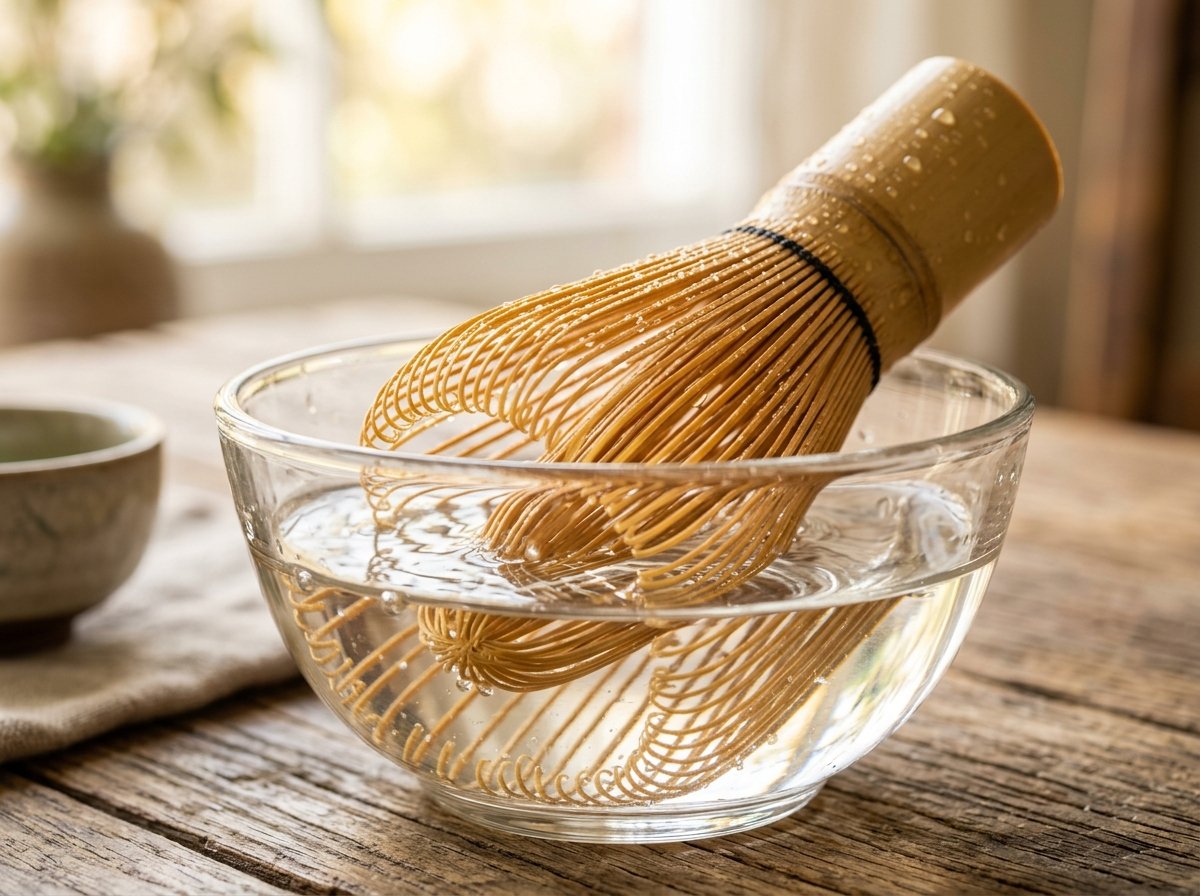
When you unbox a brand-new chasen, you will observe that its outer tines curve inward at the tips, while the center core is tightly knotted into a closed spiral. Never attempt to whisk matcha straight out of the box. Dry bamboo is brittle and will fracture instantly upon meeting the bottom of your ceramic bowl.
Before its inaugural tea ceremony, the whisk needs a short warm-water soak, often called “blooming”:
Why do handheld blenders produce bubbly, unstable froth while a bamboo whisk creates a dense, silky crema reminiscent of an espresso? The answer lies in fluid turbulence and shear forces.
Motorized blades slice through liquid at thousands of RPMs, creating giant, irregular air bubbles that collapse within two minutes. A bamboo whisk, by contrast, operates through dozens of flexible tines moving simultaneously through the water-tea suspension. Each tine creates a micro-vortex, shearing large air bubbles down to microscopic diameters (less than 100 microns). These microbubbles adhere to the natural tea saponins, yielding a velvety foam that holds for several minutes.
Bamboo is an organic, porous vascular plant tissue. Its capillaries drink in whatever liquid touches its surface. Therefore, the single greatest cardinal sin in tea utensil maintenance is using chemical dishwashing soap.
Detergent molecules penetrate deeply into the bamboo fibers. No matter how thoroughly you rinse, hot water in your subsequent tea session will draw those detergents out into your matcha, ruining the delicate amino acid sweetness with synthetic perfume and chemical bitterness.
If you let a wet bamboo whisk dry resting on its base or standing upright on its handle, gravity and surface tension will conspire against you. As the bamboo dries, the outer tines will contract and curl inward, turning your wide whisk into a tight, narrow broomstick that cannot create foam.
This is where the Kusenaoshi (whisk shaper / keeper) becomes an essential companion:
Cause: Mold spores multiplying due to storing the whisk inside a closed cabinet or plastic case while damp.
Remedy: If caught early, rinse in warm (not boiling) water, brush gently with an old soft toothbrush, then air-dry completely in open, moving air. If mould has spread into the tines or the inner stalk, replace the whisk.
Cause: Whisking against the bowl wall or knocking the whisk against a sink edge.
Remedy: Soak the tines in hot water (70°C) for 5 minutes until fully pliable. Gently straighten the bent tine between your fingertips, then mount the whisk onto a ceramic Kusenaoshi and let it dry completely.
Cause: Stirring in circles or using boiling water (100°C) which destroys the surface tension of tea saponins.
Remedy: Cool your water to 75°C–80°C. Whisk strictly in a rapid ‘W’ flick, ending with 10 seconds of shallow surface gliding to micro-shear large bubbles into silk.
Lifespan: a few months to about a year of daily use | Material: Natural White Bamboo
While electric frothers can mix powder in a pinch, their high-speed rotational blades chop through liquid rather than shearing it, creating thin foam filled with volatile air pockets that rapidly dissipate. A bamboo chasen aerates gently across dozens of parallel tips, creating a durable, silky crema with sweet, lingering mouthfeel.
With proper pre-soaking and drying on a Kusenaoshi, most good 100-tine whisks last a few months to about a year of daily use. If tines begin snapping or the core loses its rebound force, it is time to upgrade.
This is completely normal and expected! The tight knot at the center is purely a transport feature of a new whisk. Once soaked in warm water, it naturally blossoms open. This open state is actually necessary for creating microfoam.
Never. The intense heat, alkaline detergents, and pressurized water jets in a dishwasher will instantly warp the bamboo, strip its natural protective oils, and snap the delicate tines.
White bamboo (Shirotake) is dried and cured naturally, offering neutral flavor and classic springiness. Smoked bamboo (Susudake) or black bamboo (Kurochiku) are aged for antique aesthetic elegance and slightly stiffer recoil, prized in traditional winter tea ceremonies.
Our bamboo chasen comes in the Luxury Cat-shaped Matcha Set — ceramic bowl, whisk, and scoop — and pairs with our stone-milled matcha.
Deepen your tea ritual with authentic terroirs, brewing insights, and artisanal teaware.
Comparing Anhui’s two crowning green teas in aroma, mouthfeel, and cultivar.
Read Guide →Distinguishing authentic Shi Da Cha whole leaves from machine-pressed counterfeits.
Read Guide →Learn why gentle 80°C brewing unlocks sweet L-theanine while taming tannins.
Read Guide →Handcrafted Auspicious Embossed Kungfu Set