
SHOPPING BAG0 ITEMS
Your Tea Basket is Empty
Hand-harvested spring mist greens, rare Keemun blacks, and Song Ru Kiln wares await.
Explore Curated Teas →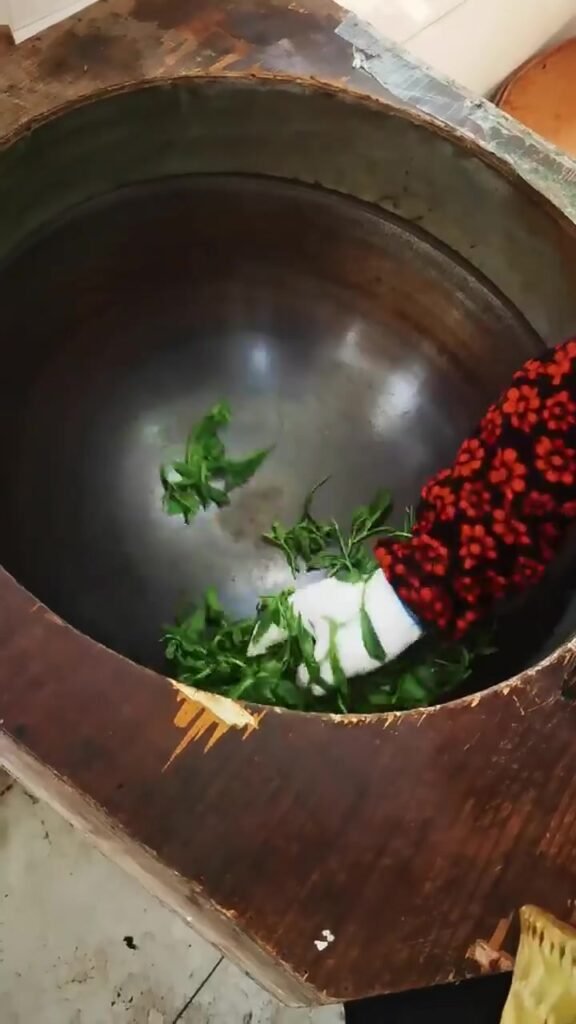
Taiping Houkui’s long flat leaf is not rolled. The first heat is a wok toss — kill-green — so the blades stay green and sweet. This clip is that step, filmed by hand in Taiping.
The clip is short on purpose. It is not a factory tour and it is not a cartoon monkey. It is one person, one wok, and a handful of long Taiping leaves that have not been flattened yet. If you only know Houkui as a dry sword in a pouch, this is the heat that decided the color.
We pack a daily lot of that tea in Anhui — Xiangcha Taiping Houkui. The leaf in the listing is the finished blade. This video is the wok work that comes first.
Green tea has to be heated soon after picking. If you skip that, enzymes keep oxidizing the leaf and you get something closer to a black tea — not Houkui. The Chinese name for the heat is shaqing: kill the green. In this workshop it is a wok, not a steam tunnel.
Watch the clip once for the motion:
If the toss slows down, the pile at the bottom of the wok cooks. If the heat is too low, the leaf stays grassy and later turns dull. The skill is boring on paper: keep every blade moving until the raw smell drops and the leaf goes limp enough to press.
Handmade Houkui is a morning, not a loop. The video is one station. Around it, in order:
Machine lines exist. They can also make a flat green. What this clip records is the version that still uses a person and a wok. That is what “handmade” means here — not a claim that every gram on earth is made this way.

Kill-green is why Houkui stays a green tea: pale liquor, orchid, a short sweet finish. Over-fired wok work tastes toasted and thin. Under-fired leaf tastes grassy and then goes stale faster. You cannot fix either mistake with a fancy gaiwan.
You can ruin a good wok job at the kettle. Boiling water on Houkui cooks the same chlorophyll the toss was trying to keep. Use 80–85°C, about 3 g, a tall glass — the numbers are in how to brew Taiping Houkui.
When the pouch arrives, you should still see the length the wok was tossing: intact blades, a clear midrib, deep green, not crumbs. If the bag is dust, it is a different product. Storage is the same as our other greens — airtight and opaque; sealed, it keeps about 6–10 months, but once opened, finish it within 4–6 weeks: how to store loose leaf tea.
Same district. Same long leaf.
Packed in Anhui. The size to try first is the 50 g pouch; tracking is emailed when it ships. Shop Taiping Houkui.
No. The video is the kill-green toss only. Picking, pressing flat, and drying happen off-camera. Those steps are why the dry leaf is a sword instead of a twist.
The wok is hot. Cotton stops a burn and still lets the hand feel whether the pile is scorching. It is not costume.
A good machine lot can still be long and flat. A bad handmade lot can still be yellow. Buy the dry leaf and the cup, not the word “handmade” on a thumbnail.
Cooler than a boil, 3 g, 2–3 minutes in a tall glass so the blades can stand. Full method: how to brew Taiping Houkui.
Deepen your tea ritual with authentic terroirs, brewing insights, and artisanal teaware.
Comparing Anhui’s two crowning green teas in aroma, mouthfeel, and cultivar.
Read Guide →Distinguishing authentic Shi Da Cha whole leaves from machine-pressed counterfeits.
Read Guide →Learn why gentle 80°C brewing unlocks sweet L-theanine while taming tannins.
Read Guide →Handcrafted Auspicious Embossed Kungfu Set